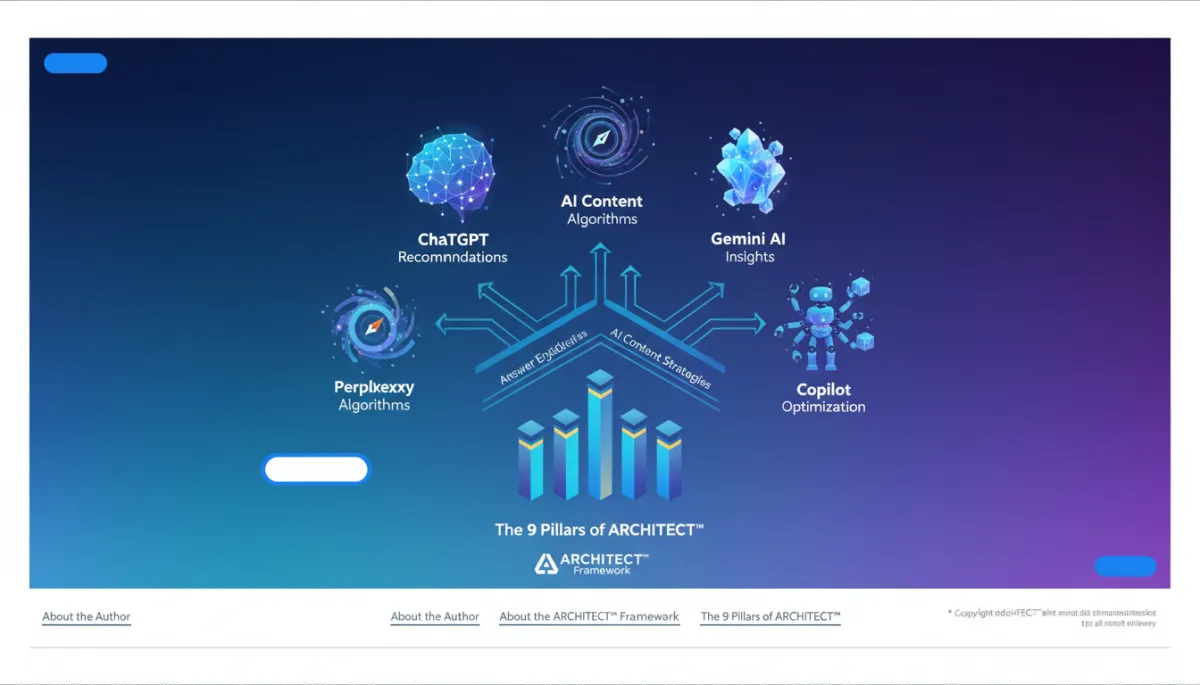
AI Answer Engines: Boost Recommendations with Strategy
AI, Answer Engine Optimization, Marketing Strategy
How ChatGPT, Perplexity, Gemini & Copilot Decide Who to Recommend
A practical, engineering-level look at how modern answer engines surface brands, and how businesses can design AI content strategies that win more recommendations across ChatGPT, Perplexity, Gemini, and Copilot.
As a senior software engineer who now spends most of my time helping marketers, I can tell you this: when ChatGPT, Perplexity, Gemini, or Copilot decide which brand to surface, it is not magic and it is not random. It is the result of layered ranking systems, safety filters, retrieval pipelines, and feedback loops that quietly decide whose content deserves to be recommended.
For agencies, small businesses, and B2B brands, this is the new visibility game. The question is no longer only “How do we rank in Google?” but also “How do we earn ChatGPT recommendations? How do we show up as a trusted source inside Perplexity algorithms, Gemini AI insights, and Copilot optimization workflows?”
At DW Conceptz, we frame this as Answer Engine Optimization (AEO): designing your content, structure, and data so that answer engines, not just search engines, choose you by default. In this article, I will unpack how these systems typically work and what you can do, practically, to align your content with how they decide who to recommend.
Take the AEO Visibility Assessment
How Modern Answer Engines Actually Decide What to Show
The details of OpenAI, Perplexity, Google, and Microsoft’s internal ranking systems are proprietary, but from publicly available research, product behavior, and my experience building retrieval and ranking pipelines, a common pattern emerges. Most answer engines follow a four‑stage flow:
Understand the query (intent, entities, constraints, tone).
Retrieve candidates (documents, tools, APIs, or brand sources).
Rank and filter (relevance, authority, freshness, safety, diversity).
Generate an answer that may cite, summarize, or recommend specific brands, products, or resources.
Whether you are targeting ChatGPT recommendations or visibility in Gemini AI insights panels, your job is to become a high‑quality candidate in step 2 and a consistently top‑ranked option in step 3. That is exactly what Answer Engine Optimization is about.
📌 Key Takeaway: You are not optimizing “for the model”; you are optimizing for the retrieval and ranking stack that feeds the model the sources it trusts most.
ChatGPT Recommendations: What Makes Your Brand Surface More Often
ChatGPT, especially in its browsing modes and business integrations, tends to pull from a mix of the open web, partner content, and structured sources. While we cannot see its exact scoring, we can infer a few practical levers from how large language models and retrieval systems are typically designed:
Semantic clarity: Content that clearly answers a focused question, with explicit headings and structured lists, is easier to match to user intent embeddings.
Topical authority: Multiple high‑quality pieces around a niche (e.g., “AI content strategies for healthcare coaches”) signal that your domain is a reliable cluster for that topic.
Consistency and freshness: Regularly updated, consistent content gives ranking systems confidence that you are not a one‑off source.
From an engineering standpoint, you can think of ChatGPT’s recommendation behavior as a weighted function over relevance, trust, and safety. A simplified pseudo‑ranking might look like this:
def score_document(query_vector, doc_vector, signals):
    semantic_sim = cosine_similarity(query_vector, doc_vector)
    authority    = signals["links"] * 0.3 + signals["brand_mentions"] * 0.2
    freshness    = signals["recency_score"] * 0.2
    safety       = 1.0 if signals["passes_safety"] else 0.0

    return (0.5 * semantic_sim + 0.3 * authority + 0.2 * freshness) * safety
This is not ChatGPT’s actual code, but it is close to how many retrieval‑augmented systems behave. Your AI content strategies should be designed to push all three knobs: semantic match, authority signals, and freshness, while staying safely within policy boundaries.
Perplexity Algorithms: Why Citations and Structure Matter So Much
Perplexity positions itself as an “answer engine” with real‑time web browsing and explicit citations. That means the Perplexity algorithms are heavily tuned around:
Document retrievability: How easily your pages can be crawled, parsed, and chunked into coherent sections.
Citation‑worthy clarity: Perplexity often quotes exact sentences. Clean, declarative statements with clear statistics are more likely to be pulled as citations.
Source reliability: Domains with consistent, non‑spammy behavior and contextual authority tend to be surfaced more frequently.
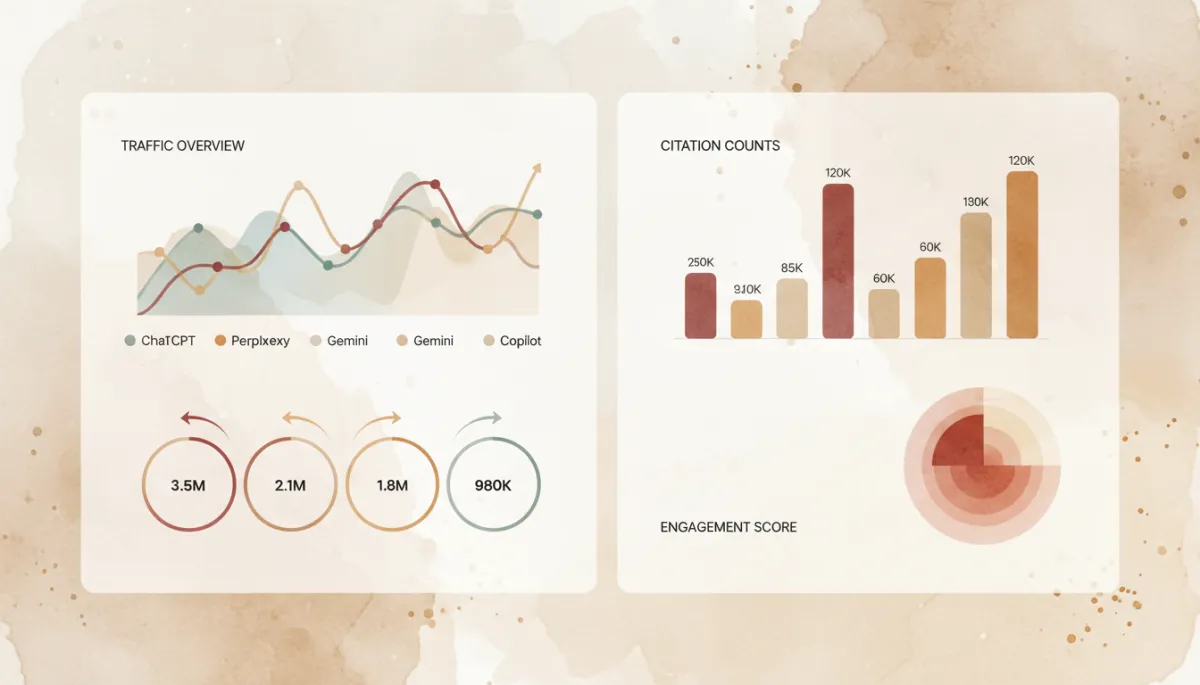
Tracking citations and answer-engine traffic reveals which content themes algorithms already trust.
For DW Conceptz clients, we often design pages where a single URL can answer a tightly scoped question in a way that is easy for Perplexity to quote. For example, instead of a vague “Services” page, we might create a focused resource like “AI Content Strategies for Boutique Law Firms in 2026” with:
A direct definition section,
3–5 concrete steps with bullet points,
Evidence‑backed statistics with sources,
Clear takeaways that can be cited verbatim.
💡 Pro Tip: Write at least one sentence per section that could stand alone as a quotable answer. Perplexity loves “single‑sentence clarity.”
Gemini AI Insights: Enterprise-Grade Context and Multimodal Signals
Google’s Gemini ecosystem has rapidly expanded, with nearly 950 million monthly active users and about 90% of Fortune 100 companies using Gemini Enterprise, according to Google’s 2026 reports. That scale matters: Gemini AI insights are increasingly shaping how decisions are made in enterprises, from summarizing Drive documents to surfacing recommended vendors or frameworks inside Google Cloud and Workspace (Google, 2026).
Gemini’s ranking behavior is heavily influenced by contextual embedding. It does not just look at a single page; it looks at how your content, brand, and structured data appear across Gmail, Docs, Drive, and the broader web. For B2B and agencies, that means:
Consistent naming conventions for your services, offers, and frameworks (e.g., “ARCHITECT™ Framework by DW Conceptz”) across PDFs, decks, and web pages.
Clean, schema‑rich pages that Gemini can interpret as entities: organization, product, service, person, FAQ, and how‑to structures.
Clear, documented processes that Gemini can summarize as “how this agency works” when executives ask for options.
Think of Gemini AI insights as the layer where your brand’s assets across Google’s ecosystem are stitched into a coherent story. If your narrative is fragmented, Gemini has less to work with when deciding whether to recommend you as a solution, vendor, or example.
Copilot Optimization: Becoming the Tool of Choice Inside Workflows
Microsoft’s Copilot is deeply embedded into Office, GitHub, Windows, and Azure. Copilot optimization is less about being cited in a web answer and more about being the resource or integration Copilot chooses when a user asks, “Help me draft a campaign plan,” “Generate a proposal,” or “Create a project template for an AI marketing rollout.”
In GitHub Copilot, that may mean your open‑source templates, starter repos, or code examples are clean, well‑documented, and popular enough to be suggested patterns.
In Microsoft 365 Copilot, it may mean your documents, playbooks, and slide decks are structured in ways that Copilot can easily reuse and adapt for new users.
For agencies, an effective Copilot optimization strategy might include publishing reusable frameworks in open formats (like GitHub repos, public templates, or documented SOPs) that Copilot can reference. Here is a simplified example of how we might model a reusable campaign workflow in JSON so internal tools or plugins can expose it cleanly to Copilot:
{
  "framework": "ARCHITECT",
  "version": "1.0",
  "steps": [
    { "id": "A", "name": "Audience", "output": "Ideal client profile" },
    { "id": "R", "name": "Research", "output": "Market and keyword insights" },
    { "id": "C", "name": "Content", "output": "Message and content pillars" }
  ],
  "usage_examples": [
    "Generate a launch plan using the ARCHITECT framework.",
    "Draft email copy based on ARCHITECT content pillars."
  ]
}
When Copilot‑style agents see consistent structures like this across your assets, they are far more likely to reuse your framework as the default pattern when helping users plan campaigns or build documents.
Take the AEO Visibility Assessment
Answer Engine Optimization: Beyond Traditional SEO
Traditional SEO asks, “How do we rank higher on a search results page?” Answer Engine Optimization asks a more direct question: “When an AI system generates an answer, how do we become the evidence, the example, or the recommended solution?”
From a senior‑developer perspective, AEO is about aligning your information architecture with how retrieval‑augmented generation (RAG) pipelines work. A typical RAG flow might look like this in code:
def answer_with_retrieval(query: str, kb):
    query_vec = embed(query)
    docs = kb.search(query_vec, top_k=10)

    ranked_docs = sorted(
        docs,
        key=lambda d: d.score * d.trust_score * d.recency_score,
        reverse=True,
    )

    context = "\n\n".join(d.content for d in ranked_docs[:4])

    prompt = f"Use the context below to answer:\n\n{context}\n\nQuestion: {query}"
    return llm.generate(prompt)
Your AI content strategies should assume that some variant of this logic is running behind every major answer engine. That means:
Create content that can be chunked into self‑contained, high‑signal passages (clear headings, short paragraphs, explicit claims).
Strengthen
trust_scoreequivalents via authority signals: quality backlinks, expert bios, transparent policies, and clear contact details.Keep your most important guides and frameworks up to date so their implicit
recency_scoreremains high.
Designing AI Content Strategies That Speak to People and Algorithms
For DW Conceptz, effective AI content strategies sit at the intersection of human clarity and machine readability. We want a founder, a CMO, and an AI model to all walk away from your content with the same understanding of who you are and what you do.
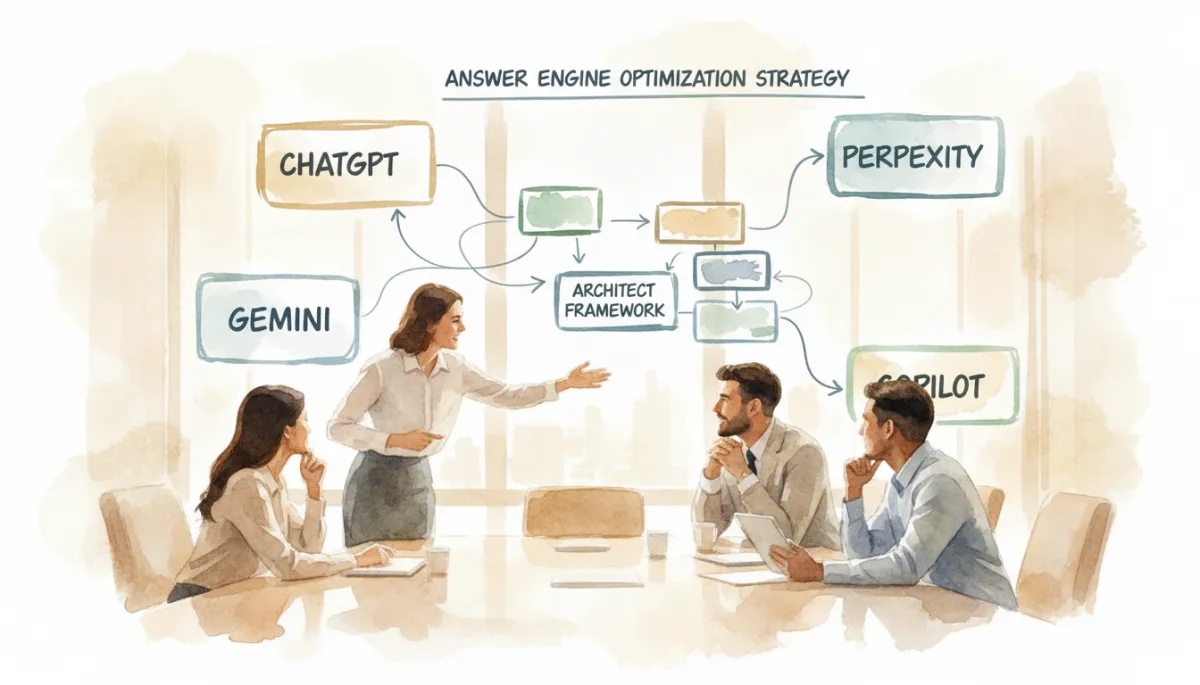
Mapping content to answer-engine behavior ensures every asset has a technical job to do.
Message first, markup second: Start by writing the clearest possible explanation for a human, then add structure (headings, bullets, schema) that helps algorithms understand it.
One page, one job: Each key URL should have a primary question it answers or a primary intent it serves. This improves semantic matching in answer engines.
Evidence everywhere: Include data, examples, and citations that answer engines can safely quote and reference.
The ARCHITECT™ Framework: Structuring Your Brand for AI Visibility
At DW Conceptz, we use our proprietary ARCHITECT™ Framework to align brand, content, and AI visibility. From a developer’s lens, ARCHITECT is essentially a system design blueprint for your marketing stack, built to be legible to both humans and answer engines.
A – Audience: Define who you serve in language that maps cleanly to search and LLM intents.
R – Research: Map the questions your audience actually asks into structured content plans that target answer engines.
C – Content: Create pillar pages and support assets designed for RAG pipelines and citation‑driven engines like Perplexity.
H – Humanization: Maintain authenticity, voice, and trust so recommendations feel credible and aligned with your values.
I – Infrastructure: Implement technical foundations: schema, fast hosting, clean APIs, and structured data for integrations with Copilot and Gemini.
T – Tracking: Measure where your traffic and citations from answer engines are coming from and which content wins recommendations most often.
E – Experimentation: Continuously test new content formats, prompts, and data structures to improve how often you are surfaced.
C – Conversion: Ensure recommended content leads to clear next steps: calls, demos, or downloads that drive revenue, not just visibility.
T – Trust: Reinforce ethical practices, transparent policies, and consistent delivery, so AI systems and humans both view you as the safe choice.

The ARCHITECT framework connects brand strategy directly to AI and AEO touchpoints.
Take the AEO Visibility Assessment
Practical Next Steps for Agencies and Service Brands
If you are an entrepreneur, agency owner, or B2B service brand, you do not need to reverse‑engineer every detail of ChatGPT, Perplexity, Gemini, and Copilot. You do, however, need a deliberate Answer Engine Optimization plan. In practice, I recommend starting with three concrete moves:
Audit your content for answer‑readiness. Identify 10–20 core questions your best clients ask. For each, ensure you have at least one page that answers it clearly, with quotable sentences, structured headings, and up‑to‑date data.
Standardize your frameworks. Document your methods (like ARCHITECT) in a way that can be reused by AI tools—clear step names, inputs, and outputs. Publish them across your site, decks, and public assets so answer engines can learn and reuse them.
Instrument and iterate. Track which pages receive traffic from AI‑driven sources, and periodically test your visibility by asking ChatGPT, Perplexity, Gemini, and Copilot questions your buyers would ask. Use the gaps as your roadmap.

Regular visibility audits keep your brand aligned with fast-moving AI ecosystems.
Bringing It All Together
ChatGPT, Perplexity, Gemini, and Copilot each have their own architectures and priorities, but they share a common pattern: they reward brands whose content is clear, structured, trustworthy, and consistently aligned with user intent. In other words, they reward brands that respect both people and algorithms.
For DW Conceptz, that is the heart of our promise: to fuse human‑centered branding with cutting‑edge AI and Answer Engine Optimization so you can grow smarter, not louder. When your content is architected for how these systems actually decide who to recommend, you stop competing for attention and start being chosen as the obvious answer.