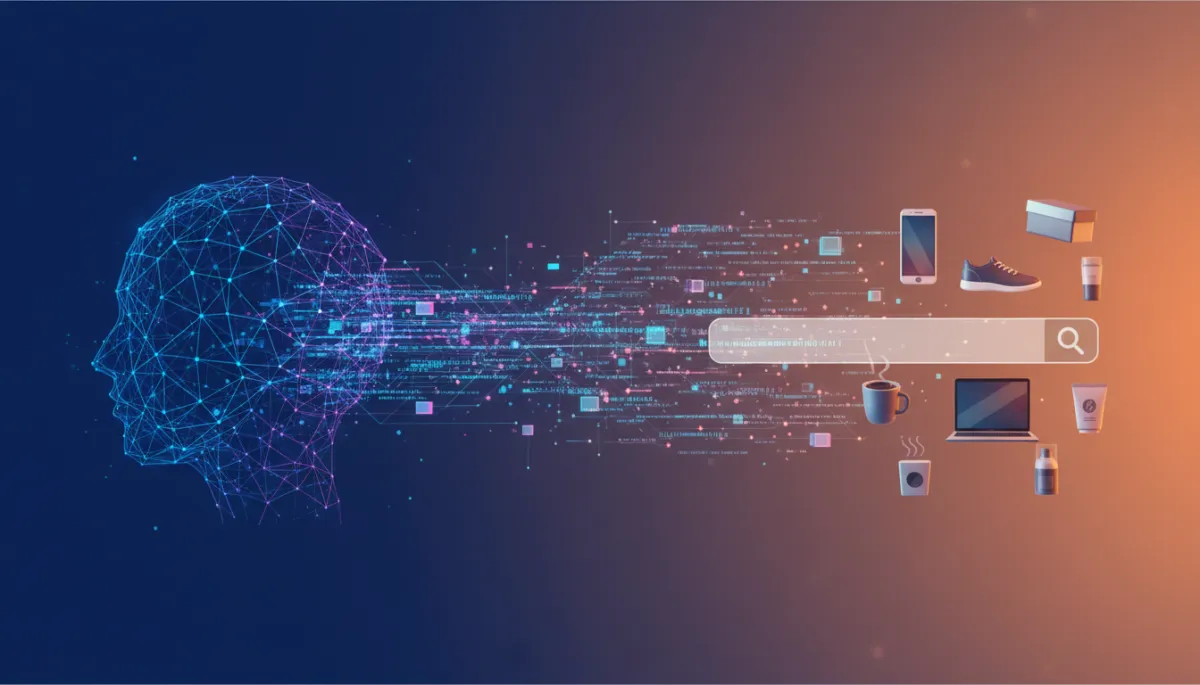
Google AI Mode: A New Era for Product Brands
AI Search, Product Brands, Digital Marketing, Answer Engine Optimization
Google AI Mode Is Replacing Traditional Search, And Product Brands Aren’t Ready
Google’s new AI Mode is quietly rewriting the rules of visibility for product brands. If your strategy still revolves around “ranking for keywords,” you’re already behind the curve.
In 2026, Google Search doesn’t look or behave like the search engine most brands built their marketing around. With AI Mode, AI Overviews, and Gemini 3.5 Flash powering conversational, multimodal experiences, search has shifted from “10 blue links” to one AI-generated answer that decides which brands show up — and which disappear.
For entrepreneurs, small business owners, and product brands, this is not a minor algorithm update. It’s a platform shift. Traditional SEO and paid search tactics alone can’t guarantee visibility inside AI Mode, where Google’s AI summarizes, recommends, and even helps customers complete purchases without ever visiting your website.
At DW Conceptz, we call this new reality the era of Answer Engine Optimization (AEO). Instead of optimizing just for search engines, brands must now optimize for AI agents, overviews, and conversations that sit between the user and the open web.
If you want to stay visible, discoverable, and chosen in this AI-first ecosystem, you need to understand what Google AI Mode is doing to product brands — and how to respond with a smarter, AI-ready strategy.
From Search Engine to Answer Engine: What Changed With Google AI Mode
Google’s AI Mode started as an experiment in 2025. By 2026, it has become the default experience for over a billion monthly users, according to Google’s own reporting. Instead of typing a short query and scanning results, people now:
Ask multi-part, conversational questions (“What’s the best cruelty-free vitamin C serum under $40, and which one is safest for sensitive skin?”)
Upload images or videos of products and ask for alternatives or comparisons
Receive an AI-generated overview that summarizes options, compares features, and suggests next steps — often before they see a single organic listing
Under the hood, Google upgraded AI Overviews to Gemini 3 in early 2026 and then to Gemini 3.5 Flash globally, making AI Mode faster, more conversational, and better at reasoning through complex decisions. Users can tap “Ask anything” or “Dive deeper in AI Mode” and continue the conversation without ever leaving the AI layer of Search.
📌 Key Shift: Search is no longer a list of options. It’s a guided conversation where Google’s AI curates which brands, products, and offers deserve to be surfaced in the answer.
How Google AI Mode Is Replacing Traditional Search for Product Brands
1. AI Overviews Now Sit Between Your Brand and the Buyer
Recent data shows AI Overviews appear in nearly half of all search queries, a massive jump from roughly 6.5% a year earlier. That means for many product-related searches, users see an AI summary first — not your organic listing or ad. The AI decides which brands to mention, which sources to cite, and which options to compare side-by-side.
For product brands, this is a visibility bottleneck. If your brand isn’t understood, trusted, and clearly defined in the data Google’s AI pulls from, you risk being left out of those summaries entirely — even if you rank well traditionally or have a strong ad presence.
2. AI Max and Gemini-Powered Ads Are Rewriting Paid Search
On the paid side, Google is sunsetting familiar tools like Dynamic Search Ads and automatically upgrading campaigns to AI Max in late 2026. AI Max uses Gemini-powered models to match search terms, expand final URLs, and customize ad text — all with the promise of around 7% more conversions or conversion value at similar CPA or ROAS, according to Google’s marketing updates.
At the same time, Google is rolling out conversational ad formats inside AI Mode itself:
Conversational Discovery Ads that appear as part of the AI’s response, guiding users through product options
Highlighted Answers where your brand provides the “official” explanation or solution within a sponsored block
AI-powered Shopping Ads that blend your creative assets with AI-generated copy and comparisons
These placements are clearly labeled as Sponsored, but they live inside the AI answer experience — not just above or beside it. For brands, that means traditional search ads are no longer the only (or even primary) way to appear when buyers ask AI Mode for recommendations.
3. Agentic Commerce and Universal Cart Shorten the Buyer Journey
Google isn’t stopping at recommendations. With features like Universal Cart and the Universal Commerce Protocol (UCP), AI agents can now:
Track prices and deals across Search, YouTube, Gmail, and Gemini
Suggest products based on user behavior and preferences
Complete purchases through UCP-enabled checkouts with retailers like Etsy, Wayfair, and soon Shopify, Target, and Walmart
When AI can recommend, compare, and help users buy in one continuous flow, the traditional funnel — impression, click, website visit, cart, checkout — compresses into one AI-guided interaction. Your brand either shows up as a trusted recommendation in that flow, or it doesn’t show up at all.
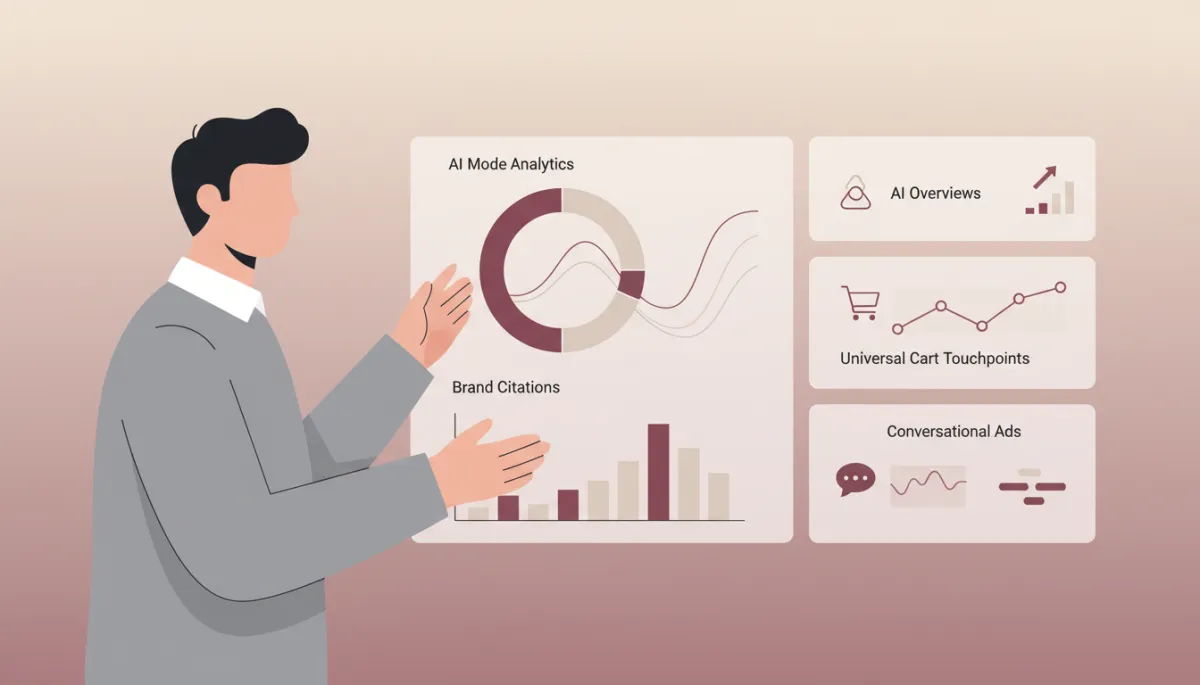
Brands that track AI citations and answer visibility can adapt faster than those watching rankings alone.
Why Traditional SEO and Search Ads Are No Longer Enough
None of this means SEO and paid search are dead. It means they’re now inputs into a much larger AI-driven system — not the final destination. Google’s AI pulls from:
Your website content and technical structure
Product feeds, reviews, and retailer listings
Third-party content, comparisons, and expert reviews
Structured data, schema, and entity-level signals that define who you are and what you sell
Studies show that when an AI assistant recommends a brand, search activity for that brand increases by over 4 percentage points and site visits rise as well. In other words, AI is now a major driver of brand discovery — and it’s increasingly deciding which brands earn that attention.
💡 Reality Check: Ranking on page one doesn’t guarantee you’ll be mentioned in AI Overviews or AI Mode conversations. If your brand isn’t “understood” at the entity level, you’re invisible where it matters most.
From SEO to AEO: How Product Brands Must Pivot Now
At DW Conceptz, we help brands move from chasing rankings to building AI-ready visibility. That means shifting your focus from “Where do I rank?” to “How does AI describe, recommend, and trust my brand?”
1. Think in Entities, Not Just Keywords
Google’s AI doesn’t just read pages; it builds a knowledge graph of entities — people, brands, products, locations, and concepts — and understands how they connect. To show up consistently in AI Mode, your brand and products must be clearly defined as entities with:
Consistent naming across your site, marketplaces, and social profiles
Structured data (schema) that labels your products, reviews, FAQs, and organization details
Clear category and attribute descriptions that match how people actually ask AI for help (“fragrance-free,” “BPA-free,” “for curly hair,” “for sensitive skin”)
2. Design Content for Questions, Comparisons, and Context
AI Mode excels at answering complex, contextual questions — not just matching exact phrases. Your content strategy should anticipate the kinds of prompts people bring to AI:
“What’s the safest stroller for city sidewalks under $500?”
“Compare eco-friendly laundry detergents for sensitive skin and hard water.”
“Which ergonomic office chair is best for people under 5’4”?”
Instead of generic product descriptions, create clear, structured, comparison-friendly content that AI can easily summarize and cite. Think buying guides, comparison tables, FAQs, and scenario-based recommendations that spell out who each product is best for and why.
3. Align Paid and Organic Around AI Experiences
With AI Max, Conversational Discovery Ads, Direct Offers, and Universal Cart all converging, product brands need a unified visibility strategy:
Use tools like AI Brief in Google Ads to guide how AI describes your brand in plain language — reinforcing your positioning and promises.
Ensure your product feeds, pricing, and availability are clean, accurate, and synced with UCP-ready platforms so AI agents can recommend and transact confidently.
Monitor not just clicks and impressions, but AI citations, share of voice in AI Overviews, and referral traffic from AI experiences.
The ARCHITECT™ Approach to AI Visibility for Product Brands
To help brands navigate this shift, Daisy Watkins, founder of DW Conceptz and Lumapath.ai, created the ARCHITECT™ Framework — a proprietary methodology for optimizing visibility across AI-powered answer engines like Google AI Mode, Gemini, and beyond.
ARCHITECT™ focuses on nine pillars that directly impact how AI understands, trusts, and surfaces your brand:
Authority – Are you a credible, expert source in your category?
Reach – Do your products appear across the ecosystems AI pulls from?
Content – Is your content structured for questions, comparisons, and context?
Hierarchy – Is your site and product architecture clear for humans and algorithms?
Intent – Are you mapping content and offers to real buyer intents across the journey?
Technical – Is your technical setup (schema, speed, feeds, UCP) AI-ready?
Entity – Are your brand and products clearly defined as entities AI can understand?
Citation – Where and how often are you mentioned, linked, and referenced?
Topical – Do you own specific topics and problems in the eyes of AI?
📌 Why it matters: AI Mode doesn’t just reward clever keywords. It rewards brands that are architected — technically, strategically, and contextually — for an AI-first world.
What This Means for Entrepreneurs, Small Brands, and Service-Based Businesses
The good news: you don’t need a Fortune 500 budget to compete in AI Mode. You need clarity, consistency, and a strategy that speaks to both people and algorithms. That’s where an AI-powered agency like DW Conceptz becomes a force multiplier, especially for:
Entrepreneurs and solopreneurs who need their flagship product to be the obvious AI recommendation in a niche category
Service-based and B2B brands whose offers are being summarized — or overshadowed — by AI Overviews and agents
Healthcare providers, coaches, and trainers who must balance visibility with trust, ethics, and compliance in AI-driven answers
In this landscape, your competitive edge isn’t just being louder — it’s being clearer, more consistent, and more AI-legible than the alternatives. That’s how you grow with confidence, convert faster, and avoid burning out trying to “beat the algorithm” every quarter.
Your Next Move: Audit Your AI Visibility Before AI Mode Leaves You Behind
Google AI Mode is not a passing experiment. It’s the foundation of how Google sees the future of search — conversational, agentic, and deeply integrated across Search, Gemini, YouTube, Maps, and more. As CEO Sundar Pichai put it, this is Google’s “biggest upgrade to Search ever,” and users are already embracing it as a natural way to get answers, plan, and shop.
For product brands, the question is simple: When AI Mode answers questions in your category, does it consistently choose you? If you don’t know — or if the answer is “probably not” — now is the time to act, not wait for another algorithm announcement.
Take the AEO Visibility Assessment
This quick assessment helps you understand how ready your brand is for AI Mode, AI Overviews, and the broader answer engine ecosystem. You’ll get clarity on:
Where your brand is strong — and where AI might be overlooking you
How well your content, structure, and entities align with ARCHITECT™ principles
Practical next steps to grow smarter with AI-ready marketing, not harder with guesswork
About the Author
About the Author
Daisy Watkins is the founder and creative strategist behind DW Conceptz and Lumapath.ai, where she helps businesses transform their digital presence through AI visibility strategies and Answer Engine Optimization.
📞 858.799.0007
📩 [email protected]
🌐 lumapath.ai | dwconceptz.com
About the ARCHITECT™ Framework
The ARCHITECT™ Framework is a proprietary methodology created by Daisy Watkins, founder of DW Conceptz, LLC, for optimizing business visibility across AI-powered answer engines.
The 9 Pillars of ARCHITECT™
Authority
Reach
Content
Hierarchy
Intent
Technical
Entity
Citation
Topical
© 2025 DW Conceptz, LLC. All rights reserved.
ARCHITECT™ is a trademark of DW Conceptz, LLC.