Website Traffic Dropping Even When Rankings Improve? A 2026 Guide for Businesses & Agencies
SEO, Website Traffic, Answer Engine Optimization, AI Visibility
Why Your Website Traffic Is Dropping Even When Rankings Improve (And What Smart Agencies Are Doing About It)
If your rankings are climbing but your traffic chart keeps sliding down, you’re not alone. In 2026, this “SEO paradox” is becoming the norm for businesses and agencies navigating AI-driven search, shrinking organic clicks, and changing user behavior. The good news: you can turn this into an advantage—if you know what’s really happening underneath the numbers.
At DW Conceptz, we see this pattern across entrepreneurs, agencies, and B2B brands: keyword positions improve, tools show more visibility, yet sessions, leads, and calls trend down. It feels like the rules of SEO changed overnight—because in many ways, they did.
This article breaks down why website traffic is dropping even when rankings improve, what’s changed in 2026’s AI-first search landscape, and how businesses and agencies can pivot from chasing clicks to building durable, AI-ready visibility and conversions.
Before we dive in, get a quick read on how visible your brand really is across AI answer engines—not just traditional search:
Take the AEO Visibility Assessment
The New Reality: Rankings Up, Traffic Down
Traditional SEO logic said: better rankings = more clicks = more traffic. But in 2026, that equation is broken. Multiple industry benchmarks show why:
59% of websites saw traffic declines in 2025, even as the cost per visit rose 9% year over year (a 30% increase over three years), according to Contentsquare’s 2026 benchmarks.
Google, YouTube, and a handful of giants still dominate attention, but traffic to the top 1,000 websites has fallen by more than 11% over five years as users spend more time inside platforms, apps, and AI interfaces than on individual sites.
Generative AI summaries in search results have slashed click-through rates: Pew Research found only 8% of users click through to a source when AI summaries are present, versus 15% when they’re not.
In other words: your improved rankings might be sitting under AI overviews, rich snippets, ads, and answer boxes that satisfy the query before a user ever needs to visit your site. Visibility is up. Clicks are not.
📌 Key Takeaway: In 2026, ranking is no longer the same as receiving traffic. Businesses and agencies must optimize for how humans and AI consume answers—not just where blue links appear.
9 Reasons Your Traffic Is Dropping Even as Rankings Improve
1. AI Overviews and Answer Boxes Steal the Clicks
Google’s AI Overviews and similar generative snippets now appear in an estimated 40–58% of search results. These AI-generated panels aggregate content from multiple sources, answer the question directly, and often push organic listings below the fold. Users get their answer without ever leaving the SERP—or the AI assistant they’re using.
For agencies reporting to clients, this creates a painful disconnect: tools show “Position 2” or “Top 3,” but the real-world click share is a fraction of what that position would have delivered three years ago. You’re visible, but you’re not being visited.
2. Search Intent Has Shifted Under Your Content
Rankings are based on how well your page aligns with search intent—today. If user behavior evolves and your content doesn’t, you can maintain a strong position while slowly losing relevance and clicks. Search Engine Journal and Moz both highlight intent shifts as a top cause of traffic drops despite stable or improved rankings.
A query that used to be informational (“what is…”) might now carry stronger commercial or transactional intent (“best tools for…”, “pricing”, “near me”).
Users may prefer shorter, more visual, or interactive content instead of long-form articles for certain topics.
If your page is still optimized for yesterday’s version of the query, AI and search engines might keep you ranked—but users scroll past you for results that better match what they want now.
3. SERP Real Estate Is Crowded and Paid Traffic Is Surging
Contentsquare reports that paid channels now make up nearly 42% of all website traffic, with paid social up 18% year over year and paid search accounting for over 25% of visits. That paid growth doesn’t just add traffic—it crowds out organic visibility with more ads, sponsored listings, and shopping units above your “organic” result.
For agencies, this means you can deliver technically “better SEO performance” while the client’s category becomes more pay-to-play at the top of the page. Organic positions are still valuable—but they don’t command the same share of attention they once did.
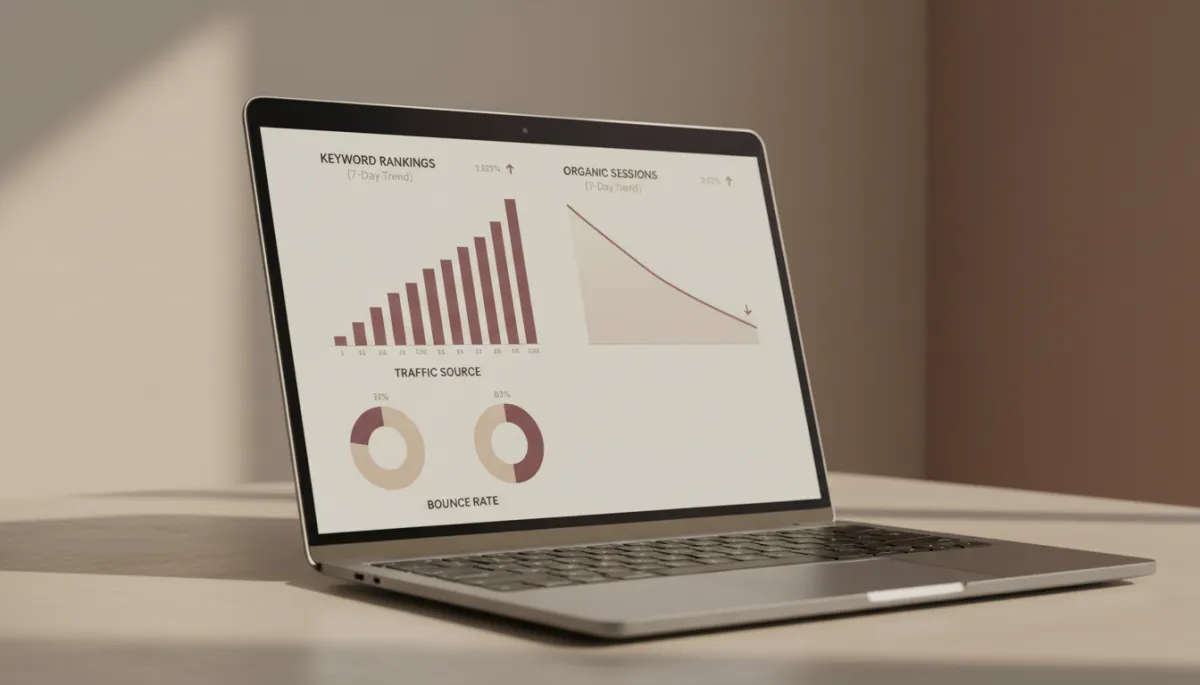
Many brands now see keyword gains while organic traffic and click share quietly erode.
4. AI and Bot Traffic Are Distorting the Landscape
Fastly and Cloudflare data show that bots now account for the majority of web requests, with AI traffic growing 6.5 times faster than human traffic. AI bots and crawlers are hitting your site more often, while human visits aren’t keeping pace. That can:
Inflate server load and infrastructure costs, even as human sessions decline.
Make analytics harder to interpret if bot filtering isn’t configured correctly.
At the same time, AI referrals still make up less than 1% of total traffic, according to Sensor Tower. AI is “reading” your content far more often than humans are clicking through to it. That’s why Answer Engine Optimization (AEO) and AI visibility matter just as much as traditional SEO now.
5. Your Content Is Ranking—but It’s Outdated or Misaligned
Many businesses and agencies did the hard work years ago: pillar pages, long-form blogs, keyword-optimized service pages. Those assets might still rank, but if they’re not updated, richer, or more specific than competitors’, users will simply choose a fresher or more helpful result—especially when they’re comparing multiple tabs or AI-cited sources at once.
💡 Pro Tip for Agencies: A structured content refresh program often outperforms net-new content creation. Updating, consolidating, and expanding existing assets around clear topic clusters can reclaim both traffic and conversions faster than starting from scratch.
6. User Experience and Core Web Vitals Are Quietly Hurting You
Rankings tools don’t always reflect how Google’s UX signals and Core Web Vitals affect your real-world visibility and engagement. Slow pages, layout shifts, intrusive pop-ups, and poor mobile experiences can lead to lower click-through rates and higher bounce rates—even when your position number looks solid. With mobile now driving over 60% of global traffic, a subpar mobile UX can erase the benefit of improved rankings almost overnight.
7. Analytics and Attribution Are Misleading the Story
Sometimes, the “traffic drop” is actually a tracking or attribution issue:
Migration to GA4 without properly mapping events, goals, and filters.
Bot filtering changes that remove previously counted sessions.
More conversions happening through AI assistants, social DMs, or chat widgets that aren’t tagged correctly.
For agencies, this is critical: before you panic—or let a client panic—validate that you’re comparing apples to apples in your analytics setup and reporting.
From Traffic to Visibility: A New KPI for Businesses and Agencies
The real shift in 2026 is this: traffic is no longer the primary indicator of digital success. With AI summarizing content, bots outnumbering humans, and SERPs fragmenting across devices and platforms, the more useful question is:
“How visible and trusted is our brand across the places people and AI go for answers—and how consistently does that turn into leads, calls, and revenue?”
At DW Conceptz, we call this AI-Ready Visibility. It blends traditional SEO, Answer Engine Optimization (AEO), and conversion strategy so your brand:
Shows up in AI-generated answers, not just blue links.
Is recognized as an authority by both humans and algorithms (E‑E‑A‑T).
Converts a smaller volume of higher-intent visitors at a higher rate.
📌 For Agencies: Reframe client conversations away from “we lost 10% of sessions” toward “we gained 25% more qualified leads from a leaner, more AI-visible footprint.” Rankings are a means, not the end.
Want to see how your brand is performing across AI answer engines and search—beyond basic rankings?
A Strategic Playbook: What Smart Businesses and Agencies Should Do Next
1. Audit Beyond Rankings: Map the Full SERP and AI Experience
For your top keywords, don’t just check position. Document:
Which AI overview, People Also Ask, featured snippets, and local packs appear above your result.
Whether your brand is cited or referenced in the AI-generated summary.
How your listing looks on mobile vs. desktop (titles, meta descriptions, rich results).
Then, test the same queries in AI assistants like ChatGPT, Gemini, and Copilot. Are you mentioned? Is your content used as a source? This is the new visibility frontier.
2. Double Down on E‑E‑A‑T and Topic Authority, Not Just Keywords
Both search engines and AI systems favor brands that demonstrate Experience, Expertise, Authoritativeness, and Trustworthiness. For businesses and agencies, that means:
Publishing in-depth, experience-based content (case studies, process breakdowns, real examples) rather than generic listicles.
Building topic clusters around your core services, with pillar pages and supporting articles that cover micro-intents and FAQs thoroughly.
Highlighting credentials, authorship, and real-world experience on key pages.

Topic clusters and E‑E‑A‑T signals help brands win both search and AI citations.
3. Optimize for Answer Engines (AEO), Not Just Search Engines (SEO)
Answer Engine Optimization (AEO) is about structuring your content so AI systems can easily extract, trust, and reuse it in answers. Practical steps include:
Writing clear, concise answer blocks (40–60 words) for key questions, using natural language and direct responses.
Using structured data and schema markup for FAQs, products, services, and reviews where relevant.
Ensuring your brand, entities, and services are consistently named and described across your site and external profiles.
💡 For Service Businesses: Turn your sales FAQs, onboarding scripts, and client questions into structured, answer-ready content. These are gold for both SEO and AEO.
4. Prioritize Quality Traffic and Conversions Over Raw Volume
With overall traffic declining for most sites and cost per visit rising, the brands that win are those that:
Focus on long-tail, high-intent queries that convert, rather than vanity keywords that impress but don’t pay off.
Optimize landing pages, forms, and offers for clarity, frictionless UX, and fast load times—especially on mobile.
Measure success in leads, booked calls, and revenue, not just sessions and impressions.
5. Refresh, Consolidate, and Modernize Existing Content
Instead of endlessly publishing new posts, build a content refresh roadmap:
Identify older posts that still rank but have declining traffic and engagement.
Update statistics, add visuals, clarify answers, and incorporate new subtopics and FAQs.
Consolidate overlapping content into stronger, more authoritative pages.
This approach not only recovers traffic but also strengthens your brand’s topical authority in the eyes of both search engines and AI models.
6. Build an AI-Ready Visibility Framework (ARCHITECT™)
At DW Conceptz, we use the proprietary ARCHITECT™ Framework to help businesses and agencies optimize visibility across AI-powered answer engines and search. It’s built on nine pillars:
Authority – Demonstrating real expertise and credibility.
Reach – Expanding where and how your brand shows up.
Content – Creating answer-ready, intent-aligned assets.
Hierarchy – Structuring your site and topics for clarity.
Intent – Matching content to real user and buyer intent.
Technical – Ensuring speed, security, and crawlability.
Entity – Making your brand, people, and offers machine-readable.
Citation – Earning mentions, reviews, and references on and off-site.
Topical – Owning key topics with depth, not just keywords.

A structured framework turns scattered SEO efforts into a cohesive AI-ready visibility strategy.
Whether you use ARCHITECT™ or your own model, the goal is the same: move from tactical, channel-by-channel SEO to a cohesive visibility strategy that works across search, AI, social, and direct discovery.
Turning the “Traffic Drop” Into a Strategic Advantage
If your website traffic is dropping even as rankings improve, it’s not necessarily a sign that your SEO is failing. It’s a signal that:
The ecosystem around you—AI, SERPs, user behavior, and paid competition—has changed dramatically.
You’re being seen, but not necessarily chosen or cited in the right places.
It’s time to measure and optimize for visibility and outcomes, not just visits.
📌 For Entrepreneurs and Agencies Alike: The brands that adapt fastest—by embracing AI visibility, refining their content, and aligning with real-world intent—will win more business from fewer but better visits.
If you’re ready to understand where your visibility is slipping—and where your biggest opportunities lie across AI answer engines and search—start with a quick diagnostic:
About the Author
Daisy Watkins is the founder and creative strategist behind DW Conceptz and Lumapath.ai, where she helps businesses transform their digital presence through AI visibility strategies and Answer Engine Optimization.
📞 858.799.0007
📩 [email protected]
🌐 lumapath.ai | dwconceptz.com
About the ARCHITECT™ Framework
The ARCHITECT™ Framework is a proprietary methodology created by Daisy Watkins, founder of DW Conceptz, LLC, for optimizing business visibility across AI-powered answer engines.
The 9 Pillars of ARCHITECT™
Authority
Reach
Content
Hierarchy
Intent
Technical
Entity
Citation
Topical
© 2025 DW Conceptz, LLC. All rights reserved.
ARCHITECT™ is a trademark of DW Conceptz, LLC.