Why Businesses Vanish from AI Platforms?
AI Visibility, Chatbots, Digital Presence
Why Businesses Are Quietly Disappearing from ChatGPT, Gemini, Claude and Perplexity
If your brand used to show up clearly in AI answers but now barely appears—or worse, is missing altogether—you’re not imagining it. As ChatGPT, Gemini, Claude and Perplexity evolve, many businesses and agencies are quietly vanishing from AI-generated results. In this guide, DW Conceptz breaks down what’s happening, why it matters, and how to protect your visibility in an AI-first world.
Are You Disappearing from AI Search?
How ChatGPT, Gemini, Claude and Perplexity Are Changing Business Visibility
The New Front Page of the Internet: AI Over Traditional Search
For years, SEO decided who owned page one of Google. Today, a growing share of your potential customers never see that page at all. They ask an AI assistant instead: “Who’s the best dentist near me?”, “What agency can help me with AI marketing?”, or “Which SaaS tools are best for small clinics?”.
Tools like ChatGPT, Gemini, Claude and Perplexity don’t just list ten blue links. They synthesize, filter and choose which brands to mention. If your business isn’t part of their “mental map,” you effectively don’t exist in that moment of intent—even if your website is technically “SEO-optimized.”
📌 Key Takeaway: AI assistants are becoming the new discovery layer. If you’re not visible there, your SEO alone won’t save you.
Why Businesses Are Disappearing from ChatGPT
ChatGPT has become the default “research assistant” for millions of entrepreneurs, marketers and consumers. But as more businesses rely on it, many are noticing something unsettling: their brand used to appear in recommendations and examples, and now it doesn’t. There are several reasons this happens.
1. Model updates and shifting training data
Each major ChatGPT model update reshapes what it “remembers” and how it ranks sources. If your brand was lightly referenced in older datasets, a new training cut or safety filter can easily push you out of its default answers. Harvard Business Review has already noted that companies regularly change AI tools due to cost, customization and performance issues—those same shifts affect who these tools surface and trust (HBR, 2023).
2. Generic content that blends into the noise
ChatGPT is trained to spot patterns. If your website, blog and social content read like everyone else’s—same phrases, same claims, same structure—there’s nothing for the model to “grab onto” as distinct. It will default to brands and resources with:
Strong, consistent topical authority (e.g., deep content on one niche, not scattered topics)
Clear positioning and language that’s easy to summarize (“X is the agency for Y”)
Widely referenced content across multiple reputable sites
3. Lack of AI-ready structure and signals
Traditional SEO focused on keywords and backlinks. AI visibility (what we call AEO – Answer Engine Optimization at DW Conceptz) adds another layer: making your brand easy for models to parse, summarize and trust. That includes:
Clear, consistent descriptions of who you serve and what you do, repeated across channels
Structured data and FAQs that directly answer the kinds of questions people ask ChatGPT
Case studies and testimonials that can be easily summarized into “proof points”
💡 Pro Tip from DW Conceptz: Ask ChatGPT directly, “Which agencies help small businesses with AI-powered marketing?” If your brand isn’t mentioned—or the answer feels generic—you have an AEO gap, not just an SEO problem.
How Businesses Vanish Inside Google’s Gemini Ecosystem
Gemini is deeply woven into Google’s world: Search, Workspace, Android and now dedicated business tools. With over 900 million monthly active users on the Gemini app by mid-2026 and AI-driven experiences powering a 22% revenue jump for Alphabet (Google, 2026), this isn’t a side project. It’s the next interface between your brand and your customers.
1. Gemini prefers integrated, verified business data
Google has started rolling out Google Business Profile integration and Business Notebooks for Gemini. That means the assistant can pull from your official business data, reviews, hours, services and content—if you’ve set it up correctly. Businesses that haven’t:
Verified and optimized their Business Profile
Clarified their categories, services and locations
Built out Q&A, reviews and consistent local signals
…are far more likely to be skipped in favor of brands that have. Gemini’s “Daily Brief” and upcoming “Remy” agent aren’t just answering questions; they’re deciding who gets recommended, booked and contacted inside Google’s ecosystem.
2. AI snapshots replace traditional search listings
As Gemini powers more AI overviews and snapshots in Search, users see fewer raw links and more curated answers. If your business isn’t seen as a strong, relevant, trustworthy source for a specific query, you may never appear in that snapshot—even if you rank somewhere on page one or two organically.
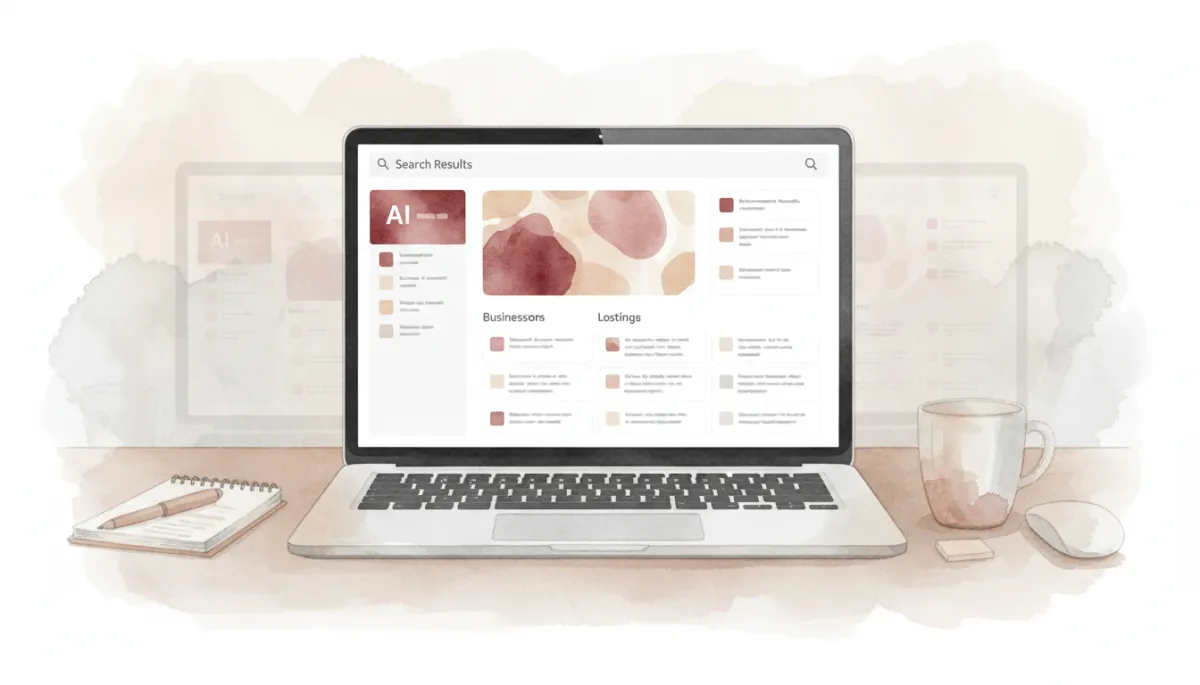
AI snapshots increasingly highlight a small set of “go-to” brands for each query.
3. Enterprise-grade AI favors clear specialization
On the enterprise side, Google’s Gemini Enterprise Agent Platform is powering AI agents across industries—from healthcare to education and professional services. These agents pull from curated, governed data sources. If your brand isn’t clearly positioned as a specialist in a defined niche, it’s less likely to be included in curated vendor lists, knowledge bases and partner directories that feed these systems.
💡 Pro Tip from DW Conceptz: For entrepreneurs, clinics and service brands, local and niche clarity beats “we do everything.” Gemini rewards sharp positioning and consistent, structured business data.
Claude: The Quiet Powerhouse That Filters for Trust and Safety
Anthropic’s Claude has built its reputation on being helpful, honest and harmless. For businesses, that means Claude is especially conservative about what it recommends and references. It’s widely used in enterprises to automate tasks, analyze data and support customer service (Anthropic, 2024), which raises the bar for which brands it’s comfortable surfacing.
1. Safety filters can push your brand out of view
If your content uses aggressive, misleading or overhyped language—think “guaranteed results,” “overnight success,” or questionable health claims—Claude’s safety systems may avoid citing you at all. That’s especially important for:
Healthcare providers and wellness brands
Financial coaches, crypto or investment services
High-ticket coaching, consulting and “make money online” niches
Even if your work is ethical, if your copy looks like the kind of content Claude is trained to treat cautiously, your visibility drops. This is where authenticity and integrity—core values at DW Conceptz—directly impact AI visibility.
2. Enterprise deployments favor “safe” vendors
As AI becomes deeply integrated into business processes by 2026 (Forbes, 2023), enterprises using Claude will often whitelist vendors and sources. That means:
Vendors with strong compliance, clear policies and transparent pricing get included
Smaller or less structured brands can be left out of internal knowledge graphs
If your goal is B2B visibility—especially as an agency or SaaS—your brand needs to look like a partner an enterprise AI system can safely recommend, not just a clever marketer on social media.
Perplexity: When AI Search Stops Showing Your Site
Perplexity positions itself as “answer-focused search.” It combines web results with conversational AI and prominently cites sources. At first glance, this feels like a win for businesses—but many brands still disappear from its answers. Why?
1. Perplexity is ruthless about relevance and authority
Perplexity typically shows a limited number of cited sources for each answer. It favors pages that:
Directly and clearly answer the question in plain language
Are fast, mobile-friendly and technically clean
Come from domains with consistent topical authority and external references
If your content buries the answer under long intros, pop-ups and vague copy, Perplexity will often favor clearer, leaner, more structured competitors—even if they’re smaller.
2. Thin or duplicated content gets ignored
Because Perplexity actively crawls and synthesizes, it spots duplicated or spun content quickly. If your blogs are AI-written without strong human editing, original insight or data, they’re less likely to be cited. For agencies and creators, this is a wake-up call: AI-assisted does not mean AI-generic. You still need a distinct voice, opinion and structure—exactly what DW Conceptz helps clients build.
The Common Thread: Why Brands Vanish Across All Four Platforms
While each platform has its own rules and ecosystem, the underlying pattern is the same. Businesses disappear from ChatGPT, Gemini, Claude and Perplexity when they:
Rely on outdated SEO thinking and ignore AI-specific visibility (AEO)
Publish generic, copy-paste content that lacks a clear point of view or niche
Use hypey or misleading language that triggers safety filters or distrust
Fail to structure their data, FAQs and brand story in AI-friendly formats
📌 Key Takeaway: AI tools don’t “hate” your brand. They simply can’t see, understand or trust it clearly enough to recommend it over others.
AEO: From Being Indexed to Being Recommended
At DW Conceptz, we think of the shift this way: SEO gets you indexed. AEO gets you recommended. For entrepreneurs, agencies and service brands, that means moving beyond “traffic” and focusing on being the obvious choice when an AI is asked: “Who should I work with for X?”
1. Clarify your positioning in AI-readable language
Your brand should be easy to summarize in a single, specific sentence. For example: “DW Conceptz is a full-service AI-powered digital marketing agency that helps small businesses and entrepreneurs grow with AI-ready, human-centered marketing strategies.” That’s the kind of sentence an AI can reuse when recommending you.
2. Build content around real questions, not just keywords
AI assistants are asked natural questions: “How do I market my local clinic with AI?”, “What’s the best way for a solopreneur to use Gemini?”, “Which agencies specialize in AI automation for coaches?”. Your content should mirror those questions and provide clear, structured answers—ideally with headings like “Question” and “Answer,” bullet points and real-world examples.
3. Demonstrate integrity, proof and sustainable results
AI models increasingly weigh signals of trust: reviews, testimonials, case studies, media mentions and consistent, non-exaggerated claims. This aligns with DW Conceptz’s core values of integrity, ethical practices and sustainable growth. When your brand story is rooted in real results and honest expectations, you’re more likely to survive future safety and quality updates across ChatGPT, Gemini, Claude and Perplexity.
What This Means for Agencies, Service Brands and Small Businesses
Whether you run a creative studio, a healthcare practice, a coaching business or a B2B service brand, the risk is the same: you can be doing great work and still be invisible in the very tools your clients trust most. The solution isn’t to chase every new AI trend; it’s to build a clear, AI-ready brand foundation and then layer smart automation on top of it.
Entrepreneurs & solopreneurs: Focus on a narrow, memorable niche and publish a handful of deep, practical guides that AIs can easily quote.
Agencies: Position yourself as the go-to in a specific industry or service (e.g., “AI funnels for coaches,” “patient acquisition for clinics”) and back it with case studies.
Healthcare providers & regulated industries: Align copy with safety and compliance best practices so tools like Claude and Gemini feel comfortable referencing you.
Don’t Wait to Vanish: Audit Your AI Visibility Now
If you’ve read this far, you probably suspect your brand isn’t showing up in AI answers as often—or as clearly—as it should. The good news: you can test and fix this before it costs you more leads, bookings and sales.
Open ChatGPT, Gemini, Claude and Perplexity. Ask them how to find a business like yours in your niche and region. Note whether they mention you—or any of your close competitors.
Search for your own brand name and see how accurately each tool describes what you do and who you serve.
Identify gaps: missing services, wrong positioning, vague descriptions, or no mention at all.
If the results feel off—or you’re invisible—that’s your signal to act. You don’t need to become an AI engineer. You need a partner who understands both human-centered branding and how modern AI systems actually surface businesses.
How DW Conceptz Helps You Stay Visible in an AI-First World
DW Conceptz is a full-service AI-powered digital marketing agency built for entrepreneurs, small businesses, agencies, healthcare providers, coaches and B2B service brands who want to grow without burning out or blending in. We combine:
Human-centered branding that clarifies your story, niche and value in language people and algorithms both understand
AI and AEO strategy that makes your brand easier for ChatGPT, Gemini, Claude and Perplexity to find, trust and recommend
Ethical automation and content systems so you can create consistently without sacrificing authenticity or integrity
💡 Pro Tip: The brands that win the next 3–5 years won’t be those who shout the loudest, but those who are easiest for AI to explain and recommend accurately.
Ready to Stop Disappearing?
Your potential clients are already asking ChatGPT, Gemini, Claude and Perplexity for recommendations. The only question is whether those tools know you well enough to say your name with confidence—or quietly route that opportunity to someone else.
If you want to protect and grow your visibility in this new landscape, DW Conceptz can help you audit where you stand today and design a clear, AI-ready marketing strategy that supports sustainable growth, not quick hacks.
Next step: Schedule a consult call or book a free 15-minute discovery call with DW Conceptz to analyze your AI visibility and start growing smarter—with marketing that speaks clearly to both people and algorithms.
About the Author
Daisy Watkins is the founder and creative strategist behind DW Conceptz and Lumapath.ai, where she helps businesses transform their digital presence through AI visibility strategies and Answer Engine Optimization.
📞 858.799.0007
🌐 lumapath.ai | dwconceptz.com
About the ARCHITECT™ Framework
The ARCHITECT™ Framework is a proprietary methodology created by Daisy Watkins, founder of DW Conceptz, LLC, for optimizing business visibility across AI-powered answer engines.
The 9 Pillars of ARCHITECT™
Authority, Reach, Content, Hierarchy, Intent, Technical, Entity, Citation, Topical
© 2025 DW Conceptz, LLC. All rights reserved.
ARCHITECT™ is a trademark of DW Conceptz, LLC.